Tiny tackers
is it a good fit for my child?
At SSA we are enthusiastic about finding a fit for your child’s swimming needs.
Our Tiny-Tackers Program is intended for infants, Babies, and Toddlers. To ensure your child is recieving an education customised to their particular learning needs, our program is divided into 4 levels of development. Levels are structured and supported by the stages of development that your little one is experiencing.
Class sizes are capped at 6 students. This allows you to receive individual attention as well as a great social atmosphere.
Our class levels are specifically designed to cater to the physical and emotional developmental milestones of infants aged 6 months through to 3.5 years.
Every Tiny Tacker Instructor completes their Austswim certified Infant Aquatics qualification, with an additional 6-12 months of extensive in-house training to ensure your child is receiving the highest quality aquatic tuition.
Classes run for 30 minutes, with one session booked per week. What would an extra 30 minutes to unplug, catchup on socials, or form new relationships with other parents;
Classes run 9:00 am – 11:00 am weekday mornings, 5:15 pm – 7:15 pm week nights and 8:30am-11:30am Saturdays
As parents ourselves, we understand that hightailing it to swimming every week can be stressful. That is why we place high value on customer comfort. Year-round, our facility’s pool deck is heated to 25 °C while our pools are heated to 32°C.
Stages of developoment
- Communication: Infants begin babbling from months 3-6. After this developmental milestone is met, infants will begin to imitate various sounds and start laughing around months 6-9. Around months 9-12, infants can imitate various sounds, communicate with gestures, and say a few simple words.
- Physical: By ages 3-6 months, infants can start to control their head movements, as well as bring their hands together. Infants aged 6-9 months can begin sitting without support and can bounce in a standing position. From months 9-12, children can begin picking up objects, crawling, and standing without assistance.
- Social-Emotional: From 3-6 months, infants begin responding to facial expressions, as well as different tones of voice. From 6-9 months, infants will respond to various gestures (such as clapping hands), and understand various emotions of others. Around this time frame, infants will also begin feeling comfortable around faces familiar to them, and anxious around strangers. Around months 9-12, infants will begin to express themselves and their emotions, as well as establish connections and relationships with those around them.
- Cognitive: Months 3-6 are when infants begin recognizing familiar faces (such as a parent), noticing music, and responding to signs of love and affection. Months 6-9 are when receptive language development occurs, where infants begin understanding and processing the words that they hear. Months 9-12 are when infants begin to imitate gestures, understand the word “no”, and explore cause and effect, such as throwing objects.
- Communication: Your child’s toddler years are when they will expand their language skills greatly. From the first year, children will say their first word and build a vocabulary of up to 5-10 different words. By 18 months, they will use up to 50 words, and start to be able to name objects and pictures, with speech primarily being telegraphic (main words are there but connecting words are not). Between 2 and 3 years old, children will begin to start saying their first full sentences, with sentences beginning as combinations of three words. Children will be able to discuss what they are doing, and their communication skills continuously improve.
- Physical: Starting at one year, children will begin to use a preferred hand (right or left), make marks on paper, and reach movement milestones. They can crawl fast, sit up easily, and can stand and walk a few steps on their own. Around two years old, confidence allows them to improve their walking, gain the motor skills to feed themself, and maybe drink from a cup! By 3 years old, children can typically dress and undress themselves, use the toilet alone, and play more – running, jumping, hopping, and riding tricycles.
- Social-Emotional: At one year, children will develop object permanence or the understanding that objects still exist even if they can’t be seen or heard. From 2 to 3 years, emotions are clear, and your child will want to do what they want. Accompanying this growing independence is a rollercoaster of feelings and tantrums as children begin to work out who they are. Otherwise known affectionately as the “Terrible Twos.” This child development stage marks the beginning of playing alongside other children, increased confidence with strangers, and an understanding that others have feelings too.
- Cognitive: As a 1-year-old, your child’s cognitive development allows them to name certain body parts and recognize familiar objects in books. During this time, they are much better at solving puzzles. From 2 to 3 years, they can name colors, recognize letters, and count numbers aloud. Children still have difficulty understanding the difference between reality and make-believe.
- Communication: Beginning at 3 years old, your child will begin to master certain difficult sounds, and can speak more clearly though they still make grammatical tense errors. Your child will start to ask a lot more questions – What? Why? How?
- Physical: At three years old, your child’s gross motor skills are strengthened every day, and we see evidence of this every day on the KCC playground! Your child has increased confidence using tricycles, walking up and down play structures, and catching balls. In the classroom, children are refining their fine motor skills using scissors, writing letters, drawing shapes, and using forks and spoons.
- Social-Emotional: At three years old, children begin to feel more comfortable around others in their life, and participate in dramatic play in the classroom. This allows your child to express imagination, and participate in various games in small groups. Children continue to understand their feelings, bodies, and understand when they have done something wrong.
- Cognitive: Your child has a much better memory, and is able to sing songs, tell stories, know numbers, and their full name and gender. They are much better at concentrating, and start reading books on their own.
Program Breakdown

TT1
Your content goes here. Edit or remove this text inline or in the module Content settings. You can also style every aspect of this content in the module Design settings and even apply custom CSS to this text in the module Advanced settings.
TT3
Your content goes here. Edit or remove this text inline or in the module Content settings. You can also style every aspect of this content in the module Design settings and even apply custom CSS to this text in the module Advanced settings.

TT2
Your content goes here. Edit or remove this text inline or in the module Content settings. You can also style every aspect of this content in the module Design settings and even apply custom CSS to this text in the module Advanced settings.
TT4
Your content goes here. Edit or remove this text inline or in the module Content settings. You can also style every aspect of this content in the module Design settings and even apply custom CSS to this text in the module Advanced settings.
Floats vs No-floats
Learn more about why our program is centered around progressing from floats to independence
At SSA, we believe that a child taught to swim and survive early in a fun, interactive, and stimulating environment improves development–And the studies back us up. Infants, toddlers, and babies exposed to curriculums incorporating number recognition, shapes, colours, and sounds show intellectual development. Our curriculum incorporates:
Number recognition, shapes, colours, songs, social cue awareness (for parents), water Safety: learning to float, treading water, doggy paddle, recovering to the edge, a love and enjoyment of water, increased coordination and balance, social skills: interacting and sharing with fellow swimmers.
Most importantly, we aim to develop respect for the water and for our parents and an understanding of our little ones’ limitations in water through guided experimentation.
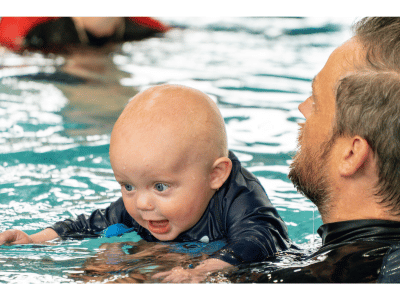
“Studies have shown effective learning is play-based for under 4’s”. At SSA, our Tiny Tacker program has developed from years of educational experience, infancy and childhood development research, and world-leading swimming instruction practices. Teachers promote an understanding of the water environment and develop skills for your little one to become independent and confident. Water-based activities develop your baby’s perceptual-motor skills, independent movement, floating, treading, and confident submersions.
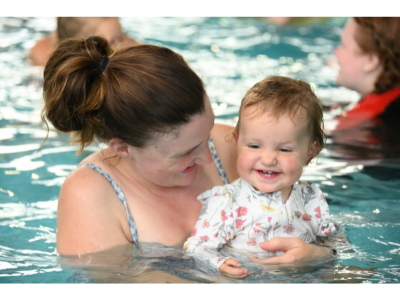
Participation requires an adult to accompany each child in our Tiny Tacker classes. The parent or guardian must be 17 years or older and be comfortable in the water.
All Tiny Tackers must wear double-layered protection in the pool regardless of toilet training. A swim nappy with firm-fitting legs to keep in any accidents is preferable. Further, a bathing suit over the top will ensure our pool water quality remains pristine.